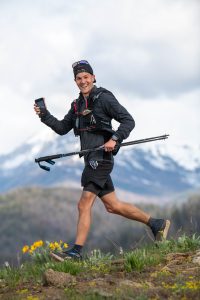
Running in wildfire smoke is a bad idea. I did it anyway. Here is what I learned. Week 7 of training for the Lake Sonoma 100.
Five miles into my run this morning, my phone buzzed.
It was Emily.
“I’m coming to get you.”
She was not asking.
Last week I told this story…
I laid in the passenger seat after my fastest 50 mile race, feet on the dash, unable to move without something hurting. I looked at my wife and said, “If I ever decide to do a 100 mile race, please stop me.”
She laughed. She did not stop me.
On October 17 I am running the Lake Sonoma 100. One hundred miles. Twenty seven thousand feet of climbing.
So this week she finally tried to stop me. Just not from the race.
First, the part that matters more than my training
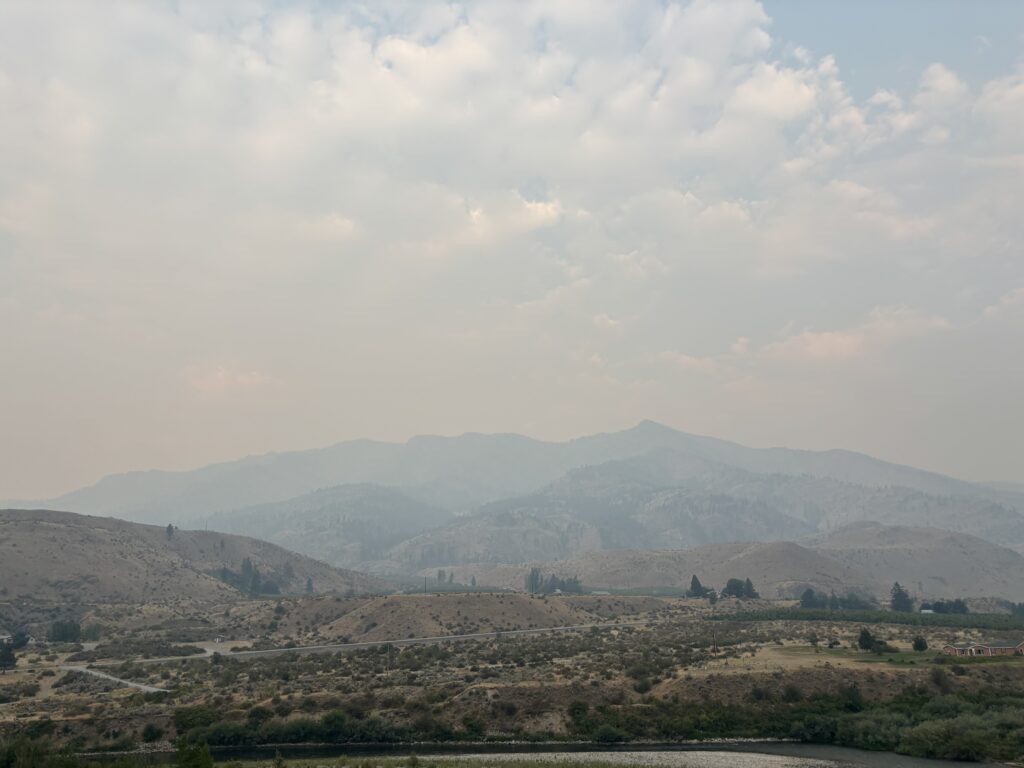
The air here has been thick with smoke for days.
For me that is an inconvenience. I lose a run outside.
For some of my neighbors, these fires have taken far more than a workout. People in our area have lost homes. Some this year. Some in years past. A few years ago we had twenty foot flames thirty feet from our house.
I do not forget that when I complain about the air.
Everything below is just about training. Training is the small thing.
Why I ran outside on purpose
Here is what people get wrong about me. I did not walk out into that smoke by accident.
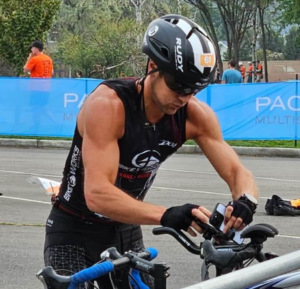
October 17 is unpredictable. Lake Sonoma could hand me heat. It could hand me wind. It could hand me rain, or cold, or dark, or smoke. Last year I raced the Chelanathon, our local triathlon here in Chelan, and the air quality was far worse than it was today.
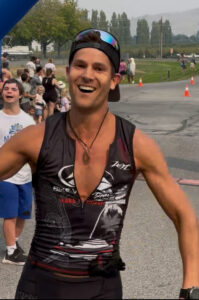
The race went on anyway.
That is the thing nobody plans for. You can do everything right for months and then the gun goes off into conditions you did not order.
So my philosophy has been simple. Push into the scenarios I do not like. Extreme heat. Cold. Dark. Wind. Wet. Find out how my body handles it now, in July, instead of finding out for the first time at mile 60 in October.
That is why I ran this morning. Train it, then support the recovery on the back end with sauna, minerals, and sleep.
I was not being reckless. I was being deliberate.
I was also wrong.
The thing I got wrong
Here is what I have since worked out, and it is the most useful thing in this post.
You can adapt to heat. You cannot adapt to smoke.
Heat training actually changes your body. Your blood plasma volume expands. You start sweating earlier. Your sweat holds onto more sodium. Do it for two weeks and the same pace in the same heat genuinely feels easier. That adaptation is real, it is measurable, and it is why I sit in a sauna four times a week.
Cold works the same way. So does altitude. So does running in the dark until your headlamp feels like a second set of eyes.
Smoke gives you none of that.
There is no particulate tolerance to build. Your lungs do not get better at handling fine particles. You just inhale them.
And it is worse when you run. At rest you might move six liters of air a minute. Running hard, that can jump past sixty. You are pulling in ten times the air. Most of it through your mouth, which skips your nose entirely, and your nose is the filter.
So a hard run in smoke is not a training stimulus. It is just exposure.
That is the distinction I did not have this morning. Train the conditions you can adapt to. For the ones you cannot, rehearse the plan, not the exposure.
What 150 AQI actually feels like
I stepped outside and it felt like walking into a sauna. Thick air. Hazy. That distinct smell of smoke that anyone in a fire town recognizes instantly.
The air quality index was 150. Worse in some spots.
For reference, under 50 is good. Around 100 is where sensitive groups should start being careful. At 150 you are at the top edge of that range and knocking on the door of unhealthy for everyone.
You feel it in your lungs. Breathing gets harder. The air feels heavy going in. Your effort climbs while your pace drops. On a normal easy run I can nose breathe most of the way. In smoke that goes out the window fast.
I was also 15 hours into a scheduled 24 hour fast. Just water and salt.
Five miles in, my phone buzzed. I finished the last two on the treadmill.
I was not embarrassed. I was frustrated. There is a difference.
And I am grateful my wife was paying attention. She did not stop me from running a hundred miles. She stopped me from spending my lungs on a Thursday in July for no adaptation at all.
What to do when the air is bad
Here is the actual advice, including the part I ignored this week.
Check before you go. www.iqair.com or any weather app. Ten seconds. I skipped this and it cost me.
Under 100, go run. Use your judgment if you have asthma or another lung condition.
100 to 150, shorten it and slow it down. Easy effort only. Nose breathe. If you cannot nose breathe, you are working too hard for the air you are in.
Over 150, go inside. The treadmill is boring. It is not the same as being on the trail. It is still the right call.
Never do hard intervals in smoke. Hard efforts are exactly when you pull the most air and breathe through your mouth the most. Save the quality session for clean air. It will still be there in three days.
How I recover on a smoky day
Bad air is a stress on your body. So on smoke days I shift the routine. Some of what I do on a clear day actually works against me when the air is bad.
Here is the smoke-day version.
Filter the air where you sleep. This is the big one. You spend eight hours a night in your bedroom. That is far more air than any run. We run an AirDoctor at home and I change the filters on schedule. Clean air while you sleep does more for your recovery than anything else on this list.
Get your morning light, but keep it short. I still get outside for a few minutes first thing. On a heavy smoke day I keep it quick, or I get my light through a window instead of standing in it.
Breathe slow, not deep. On a clear day I love Wim Hof breathing. Not on a smoke day. Big forceful breaths pull fine particles deep into your lungs, which is the opposite of what you want. When it is smoky I switch to slow, gentle nasal breathing. Longer exhale than inhale. Save the big breathwork for when the air clears.
Cold therapy. A cold plunge or cold shower still works, smoke or not. I do this most mornings.
Replace your minerals. When you sweat hard you lose more than water. I use Land and Sea Minerals to put back what the miles and the sauna take out.
Support your body’s own detox systems. Your liver and kidneys are what actually clear what you breathe in. My job is to support them, not replace them. Whole food comes first here. Cruciferous vegetables, plenty of water, quality protein, and enough fiber to carry things out. I also take a few targeted supplements to support liver and antioxidant function during smoke season. If you want the specific ones I use and why, I keep the full list here.
Get adjusted. I see the chiropractor regularly. Not because I am hurt. Because I intend to stay that way. Smoke does not change this one.
And sit in the sauna. This is my favorite recovery tool of the whole training block, and it earns its own section below.
About the sauna
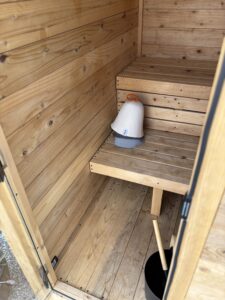
We built it this year, in the backyard.
We had wanted one for years and kept putting it off. What finally moved us was simple. We wanted a place of peace out back where our family could recover in every season, including the dark stretch of winter when the sun disappears around here.
Best thing we have added to our home. Twenty minutes after a long run and my legs are a different set of legs the next morning.
The rest of the week
Saturday I ran 22 miles of hill work. Out and back, then out and back again. It felt great. No soreness after.
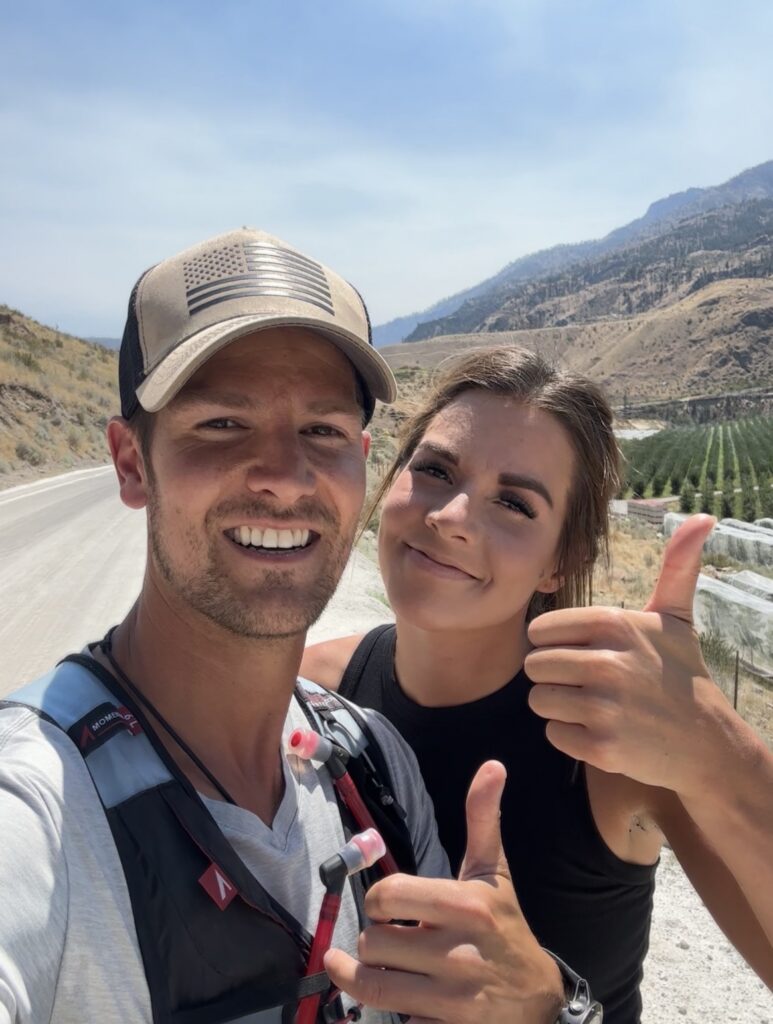
Sunday I was supposed to run 10 more. It did not happen. Family time won.
I used to treat a missed run like a crack in the foundation. It is not. I got up early Monday and got the 10 in. The plan survived and my family got Sunday. I will make that trade every time.
One thing that is working: I have been running Perfect Aminos before and Maurten during. Twenty two miles of hills and no soreness is not normal for me.
I am not going to pretend a supplement did that. Sleep, food, strength work, and getting adjusted did that. But the fuel is doing real work and I have noticed.
The lesson for the week was simple. When training gets hard, nutrition is the first thing to slip and the last thing you can afford to lose.
If you want the full list of what I take and why, it is all written out here.
What’s next
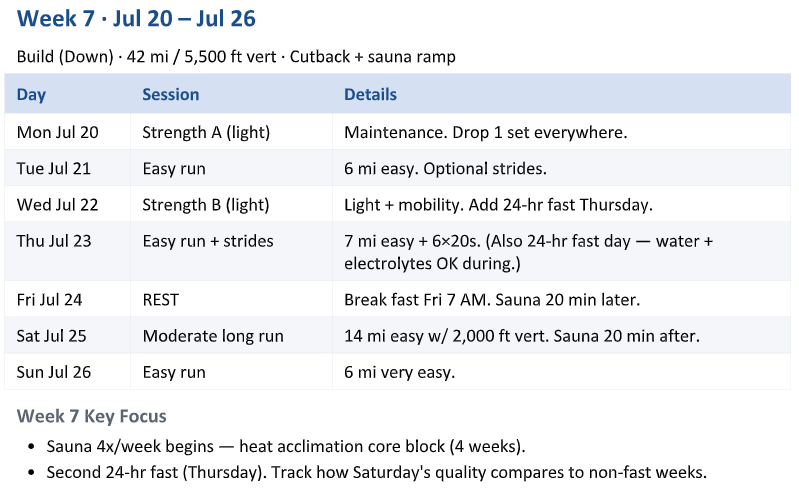
Friday is a rest day. I break the fast and sit in the sauna.
Saturday is 14 miles with 2,000 feet of climbing. And I am going to check the air quality before I walk out the door.
You know. Like I should have done today.
Your turn
Have you had to train through wildfire smoke? What did you do?
Drop it in the comments. I read every one and I answer every one.
Made it this far? Then this one’s for you.
A new patient exam is a full workup. Exam, consult, and a real plan for your body. Normally $400. For the people following along on this journey, it’s $65 with code 7KEYS65.
Grab it here. Just mention you read this.
This is week 7 of The Road to 100. If you are just finding this, start at the beginning, or follow the whole series here.
Dr. Nate Moller, D.C. is a chiropractor and nutritional coach in Chelan, Washington. He works with runners, athletes, and active families, and he is training for his first 100 mile race on October 17, 2026.