


By Dr. Nate Moller, D.C. | Living Well Family Chiropractic, Chelan, Washington
Road to 100. The Lake Sonoma 100, October 17, 2026.
Short version: I did not finish. I covered 51.94 miles of the Lake Sonoma 100 in 16 hours and 39 minutes and then I stopped, with my legs under me and my head clear. This is the honest version of why, what worked, what did not, and the one decision I would take back.
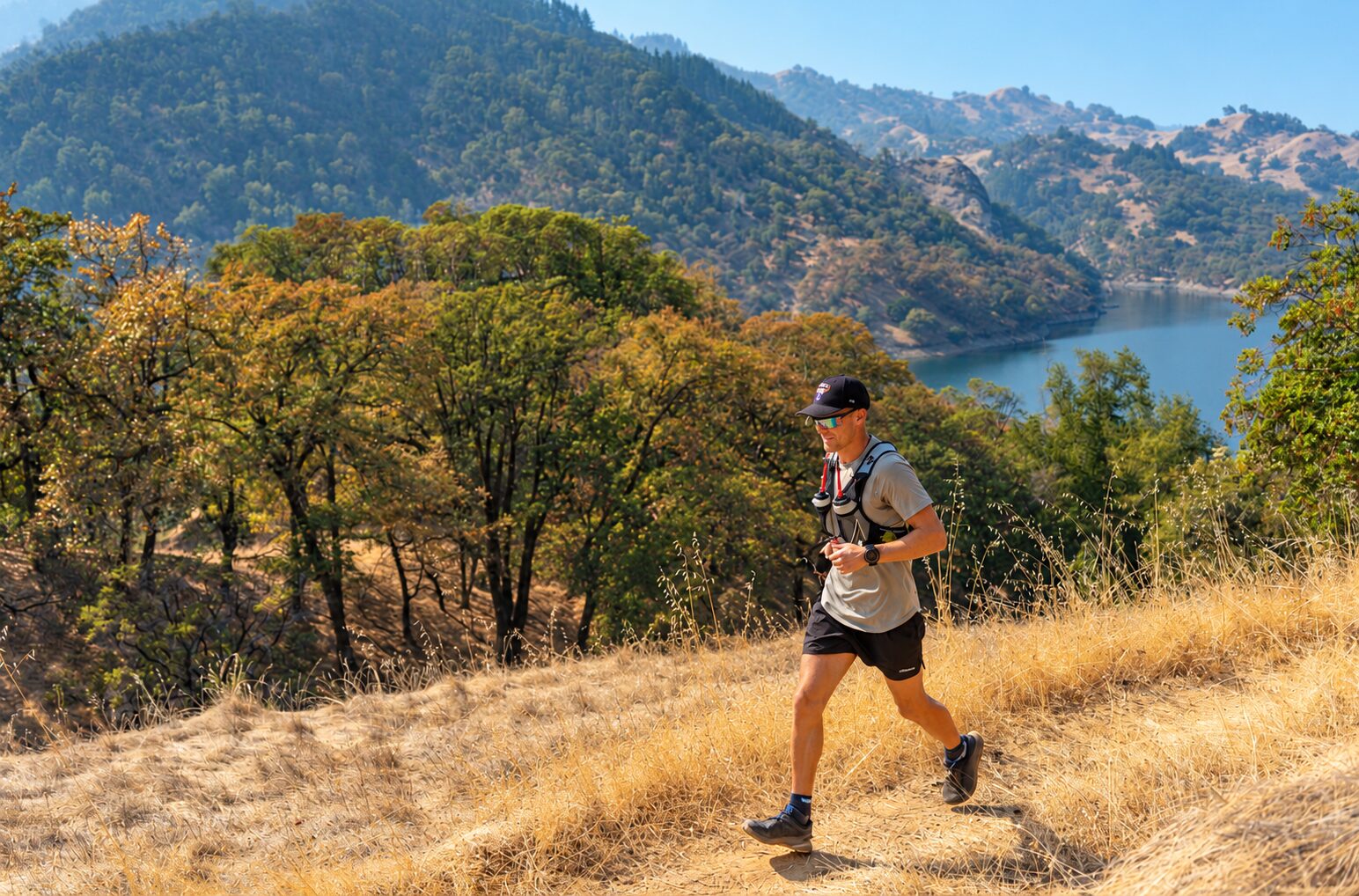
Walking up to the timing tent and telling a stranger I was done is the worst I have felt in a long time.
First DNF of my life. Four months of training, fourteen blog posts, 4:30 alarms since June, and I handed in my bib at mile 52.
I want to tell you about that. But I have to start somewhere else, because the ending does not make sense without the morning.
3 AM
Three eggs, half an avocado, two pieces of toast and a glass of Perfect Aminos, standing at a hotel stove at three in the morning.
It was hard to get down. Nothing about that is appetizing at 3 AM. But I knew I needed as much real food in me as I could manage, because the next reliable chance was hours away and the day was going to ask for about seven thousand calories.
So I forced it.

Four drop bags were already packed and labeled. Start/Finish. Warm Springs. Lone Rock. Bib 63.

The start line
I almost cried at the start line.
That surprised me. I am not an emotional guy, and I was not afraid. It was something else. Aravaipa put on a genuinely great race. DJ, speakers, music going, a race director named Skip who clearly loves this thing. And there I was at 5 AM in the dark, looking at my wife and kids one more time before walking into something I had never done.
Overwhelmed and excited at the same time. There is a specific feeling that only shows up a handful of times in a life, and that was one of them.

Then we went up Pritchett Peak in pitch black with nothing but headlamps.

Chris and I played the alphabet game going up. Every runner we passed got something starting with the next letter. Amazing day out. Best of luck to ya. Can’t quit, don’t quit. We were laughing on a brutally steep climb in total darkness at five in the morning.
That is one of my favorite memories of the whole year.
Mile 15
Chris’s knee went at mile 15.
Not a twinge. A seven out of ten that showed up and stayed there for the next thirty-seven miles.
We had a plan going in. We were going to run this thing together, start to finish, and that had been the plan for months.
So at mile 15 a question came up that we had never once talked about. Push on, or stay.
I stayed.
I do not regret that part. I would make that call again. But I want to be straight about what it meant, because the rest of this post does not add up without it: from mile 15 to mile 52, I ran Chris’s pace, not mine. He could not take steep downhills at all. We walked things we would have run. I spent large parts of the day waiting at aid stations.
He was in real pain and he kept going anyway, for thirty-seven miles, on a course with 25,058 feet of climbing in it. If that knee had held, I believe both of us cross that line together. No question in my mind.

And here is the part I want to say clearly, because it is easy to miss.
Chris had a job in our plan, and it was not keeping up with me. It was the opposite. He was there to hold me back early.
I am the guy who goes out too fast. I have done it my whole life, starting with the first cross country race of my college career, where I sprinted off the line, led the field for about thirty seconds, and then got passed by nearly everybody before finishing in the grass. That instinct has never gone away. My pace was faster than his on paper, and the single biggest threat to my race was me burning the first twenty miles and paying for it at seventy.
So for the first fifteen miles, Chris was protecting me from myself. That was the deal.
Then his knee went, and the deal reversed, and I stayed.
The middle of the day
Some things from out there that I do not want to forget.
Mile 12, give or take. We came back off Pritchett and Emily and the kids were waiting. I was not expecting that. A kiss from my wife, hugs from my kids, music going at the aid station, and they sent us out with homemade peanut butter, banana and honey wraps. That is as good as a day gets.
A horse trough. One mid-day aid station was a pipe running water into a trough with green slime in it. Chris was completely out of water. You take what you get.

The guy at that trough had run this course many times. He was doing the marathon as training for a hundred in Rio in two weeks. His advice about the Falcon’s Nest section was four words long and three of them are not printable. The polite translation is do not run it.
I understood him completely about an hour later. That section is straight out of somewhere unpleasant, and we got to do it twice.
My headlamp died coming out of Falcon’s Nest around seven in the evening. I ran in whatever light spilled off Chris’s lamp until we reached Lone Rock.
Poles. Our crew, Emily and Kelli and the kids, brought our poles to Liberty Glen at mile 33.6. On a course that is relentlessly steep and technical with almost no flat, those poles make a huge difference.
An ice bandana. A handkerchief you fill with ice and tie around your neck. In the heat of the day with water running down my shirt, that thing was worth its weight in gold. All the sauna work this summer helped too.

Mile 46.25
Emily joined us at Lone Rock the second time through and paced us in.
She and the kids brought a hamburger and a milkshake. I could manage about three bites of it and it was still one of the best meals of my life.
Then she ran with us. Music playing off her phone, the three of us talking and laughing about the day, all the way to the fifty.
My son wanted to run a stretch with us. It was pitch black by then and it was not the place for it. That one stung a little.
But my wife, out there on the course with me instead of waiting at the end of it, meant more than anything else that happened that day.

51.94 miles. 16 hours, 39 minutes, 23 seconds.
Distance: 51.94 miles of a 100.5 mile race.
Total time: 16:39:23. Moving time: 14:06:43.
Climbing: 10,856 ft up, 10,761 ft down.
Temperature: 55°F at the start, 99°F at the hottest point of the day.
Average heart rate: 139 bpm. Calories: 7,475.
We rolled into the fifty about twenty minutes ahead of the cutoff.
And here is where I made the decision I keep turning over.
Emily told me to keep going if I wanted to. She meant it. But I knew she did not love the idea of me out there alone all night, and in my head I had the next part all wrong.
Her plan had been to pace me on the Pritchett section again, 5.8 miles up and 5.8 back, brutally steep up and steeper down. Earlier that morning Chris and I had both looked at each other on that climb and said that was no place for Emily. Way steeper than either of us expected and she had not trained for it.
So in my head, the choice was: ask my wife to do something we had already agreed she should not do, or ask her to take on the whole back fifty with me.
Two families, one van, thirty minutes from a bed, kids who had been up since four in the morning.
I thought I would be chasing cutoffs the whole second half anyway.
I called it.
What I actually wanted
Here is the part I have not said out loud yet.
I wanted this one badly. Not the buckle. I had a very specific picture in my head and I had been carrying it since summer.
Back in August, my son asked if he could run the last two miles of this race with me. He knew what he was asking. He had watched me go fifty before. We had done five and six mile hikes as a family, so distance meant something real in his body. I hugged him and told him I would love that.
That was the picture. Coming up the last stretch with my wife on one side and my son on the other.
That is what I lost at mile 52. Not a finish line. That.
And the hard part is that I am the one who traded it away, for reasons that were about those same people.
The math I got wrong
Here is the part that bothers me.
The overall cutoff for the hundred was 36 hours. I was at 52 miles in 16:39.
That left me more than nineteen hours to cover the remaining 48.5 miles. About twenty-four minutes a mile. That is walking pace, with time to sit down.
To be fair to myself, the back half is the harder half. My first 52 miles had 10,856 feet of climbing in them. The full course has 25,058. So the second half was going to ask for considerably more than the first.
Even so. Nineteen hours.
I was not going to be chasing cutoffs. I had an enormous window and I did not see it, because I was doing arithmetic after sixteen and a half hours on my feet.
You should not make a decision like that in that state. I knew it in theory. I wrote about it. I did it anyway.
What I should have done was sit for ten minutes, eat something real, let my brain come back online, and then decide. I might have made the same call. But I would have made it awake.
The number I did not expect
I pulled my watch data apart when I got home, and one line stopped me.
Total time: 16 hours, 39 minutes. Moving time: 14 hours, 7 minutes.
I spent two and a half hours of that race standing still.
That is fifteen percent of my day standing around. Some of that is normal. You eat, you fill bottles, you deal with your feet. The rest of it is just what the day was, and I signed up for that day on purpose.
But here is why the number matters. Cut that stopped time in half and I reach the fifty more than an hour earlier, with a completely different set of numbers in my head when I sit down in that chair.
I am not putting that here to re-run the race. I am putting it here because the number in my head is what made the decision, and the number in my head was wrong.
What I never found out
Here is the thing that actually haunts me a little.
I was fine.
Here is the proof. My average heart rate for the entire sixteen and a half hours was 139.
My zone 2 ceiling is 150. I ran a hundred mile race, in temperatures that hit 99 degrees, over ten thousand feet of climbing, and I never left zone 2. Not once, on average, across an entire day.
Mentally I was clear the whole time. Never got low. Never got dark. Physically, apart from two blisters on my left foot, I had plenty left. I genuinely believe I could have walked out another thirty or forty miles.
I spent four months training for a race I signed up for partly to find out where my breaking point is. I wrote that down in September. I wanted to know who shows up when everything in your body is screaming at you to stop.
I never got there.

I had a whole kit saved for that moment. Music playlists I had been building for months. Mental techniques. Chunking the race into pieces. Brushing my teeth to feel human again. This was the first race of my life where I never put a single song on, because I never needed to.
All that preparation for a low that never came.
I came home grateful and whole and able to enjoy the rest of the trip with my family, and I came home not knowing the one thing I most wanted to know.
Both of those are true and they do not cancel each other out.
What worked
Salt Sticks, one per hour. In that heat this was the single easiest thing I did right. One pill an hour, no thinking, no guessing. After a summer of learning that a lick of salt is not a number, having something countable mattered.
Scratch in one bottle to keep sodium steady alongside the pills.
Real food at aid stations. PB&J and, my new favorite discovery in all of endurance sport, baked potatoes with salt. I liked them so much I left one aid station with a pocket full of potatoes.
Poles, from mile 33.6 on. Steep, technical, relentless. Almost no flat anywhere on that course.
The ice bandana. Changed the entire middle of the day. It hit 99 degrees out there and that thing, with water running down my shirt, made the heat survivable.
The sauna work. Months of heat adaptation, and on a day that went from 55 at the start to 99 at its peak, I handled it fine. That is the one piece of preparation I would call unambiguously validated.
What did not
My shoes were too loose. That is the whole blister story. I was sliding around in them and picked up two on my left foot, noticed at Liberty Glen at mile 33.6. I taped around them and left them alone rather than popping them, which was right for that moment. If I had gone on I probably would have drained them at fifty.
My shoe choice for this distance. I love the Flux trail running shoe and I will keep running them shorter distances. The grounding tech is great. But the anti-debris knit collar irritated my ankle in a way I had never noticed on anything under forty miles. For long days I am going back to the Altra Timp.
Maurten past mile 40. It worked well all day and then it stopped working. It goes down like syrup, which is fine early, and late in a race it starts actively fighting you. I had to force it. Lesson: do not plan to run a hundred miles on one flavor of anything.
My headlamp. Rechargeable, and it died at the worst time. You cannot charge it and use it at the same time, which turns out to matter a lot at mile 45 in the dark. Next time: battery powered, with spare batteries in a drop bag. The UltrAspire waist light I picked up later was excellent, and my wife ran the whole night on a Black Diamond headlamp that never flinched.
Toothbrush placement. Sounds trivial. Sixteen hours in, brushing your teeth makes you feel like a person again. I had one at the start/finish aid station. Next time I put one in every drop bag.
The shoes, salt, lights, poles and supplements I used out there are all on my products I use page. Some of those are affiliate links.
What I would tell you
Three things, and the first one is the one I actually want you to take.
Do not go into your first hundred alone.
Chris and I never talked about what we would do if one of us could not go on. It never came up. We were both going to finish, and we were going to do it together.
That was not just a nice idea between two friends. It was a condition.
Emily was nervous about this race, and she was right to be.
In August, Jeff Browning had a heart attack eighty miles into a race in Chamonix. They defibrillated him at an aid station and airlifted him out, and he ended up with three stents. I have looked up to that guy for years. I got to run beside him for a few minutes at Cold Water Rumble. That one landed hard in our house.
And this one is not abstract in our house.
Years ago my blood pressure shot up out of nowhere and would not come down. I got an EKG. I ran test after test. Nothing explained it.
What finally found it was Nutrition Response Testing, which is the same work I do with patients today. The practitioner found a chemical sensitivity. A few supplements, about two weeks, and my blood pressure was normal again. I have not had a problem since.
To be clear, I did the medical workup first and I would tell any patient to do the same. High blood pressure deserves a real evaluation. The point is only that in my case the answer was not where anybody expected to find it.
So my wife has watched my heart do something nobody could explain. She did not want to spend a night wondering where her husband was on a mountain in the dark. She wanted me to come home.
So she asked me to stay with Chris. I said yes, because she was right, and because I would have asked the exact same thing of her.
That means mile 15 was never really a decision. I made it back in June, with my wife, with my eyes open, and I would make it again today.
Here is the part I got wrong, and this one is mine alone.
Somewhere in those sixteen hours, quietly, I started keeping score. Never out loud. Never to Chris. But in the back of my head I was adding up the race I might have had, and a tired brain running that kind of math will talk you into almost anything.
That is not on Chris. He gave me thirty-seven miles on a knee that had no business going one more step. And it is not on Emily. At mile 52 she was the one telling me to keep going.
So if you are headed into a distance you have never touched, go in with somebody. And if the person who loves you asks for something that keeps you safe, do not treat it as a limit on your race. It is the reason you get to have a race at all.
Never decide to stop while you are sitting in a chair at a cutoff.
Your brain at hour sixteen is not the brain that signed up for this. Sit. Eat. Give it ten minutes. Then decide.
Do the math on paper beforehand.
Know, for every aid station, what pace you need from there to finish. Put it in your drop bag. Because the one thing you will not be able to do at midnight after sixteen hours is arithmetic, and I have the DNF to prove it.
One number for scale
Thirty-six people finished the hundred. Forty did not.
More runners DNF’d that race than completed it, which tells you something about the course and nothing at all about my decision. They call it the Sufferfest and the name is earned.

I am not putting that here as comfort. My stop was a choice, not the mountain beating me, and I do not get to hide inside a statistic.
But if you are a runner reading this and carrying a DNF of your own around: at this distance, on this kind of terrain, not finishing is the more common outcome. That is just what the sport is.
Where I go from here
I do not know if I will ever go back for a hundred.
Maybe when the kids are bigger. The training took so much from my family, and I wrote honestly about that in September when I was still deciding whether to start at all.
What I do know is what I want next.
My wife ran six miles of a mountain race with me in the dark and it was the best part of my year. We are looking for a 20 miler or a 50K to train for together. Both of us out there, not one of us waiting at the finish.
That sounds better to me than any buckle I could have earned alone.

The honest ending
I am disappointed in myself. I made a decision while depleted that I would not have made rested, and that one is mine.
I am also grateful. I came home in one piece. I had a great day with a good friend who was hurting and did not quit. I got to run through the dark with my wife. My kids saw their dad do a hard thing and then saw him choose them.
Four months of work does not evaporate because of a DNF. That body is still built. Those habits are still mine. The thing I actually said I wanted back in June was to be moving well at ninety, and none of that changed on Saturday.
But I will be honest with you: I would still like to know what is down there at mile eighty.
Maybe someday.
Have you ever stopped something and wondered afterward if you quit too early? Tell me in the comments. I read every one.
The whole series: why I signed up, running in wildfire smoke, the treadmill run nobody posts about, 22 miles on a fifth of the fuel, why people quit fitness goals, what else can this body do, and what this race was costing my family.
Frequently Asked Questions
What does DNF mean in ultrarunning?
DNF stands for Did Not Finish. It means a runner started a race but stopped before the finish line, whether because of injury, missing a cutoff time, or choosing to withdraw. Rates vary widely by course and conditions, and at hard mountain 100 milers they can exceed half the field. At the 2026 Lake Sonoma 100, 36 runners finished and 40 did not.
How do you prevent blisters during an ultramarathon?
The most common cause is foot movement inside the shoe, so getting lacing tension right matters more than most people expect. Other factors include moisture, debris, and sock choice. If a hot spot appears, address it at the next aid station rather than waiting, and consider taping over an intact blister rather than draining it mid race unless it is affecting your gait.
Should you run an ultra with a partner?
It can be one of the best parts of the experience, but agree in advance on what happens if one person gets injured or falls off pace. Deciding that during the race, while watching a friend struggle, is a much harder conversation. Naming a specific point where you would split up removes the guilt from the decision for both people.
Why do runners struggle to eat late in a long race?
Blood flow is diverted away from the digestive system during prolonged exercise, which slows gastric emptying and makes food harder to tolerate as hours accumulate. Heat makes it worse. Practical responses include carrying several different flavors and textures rather than relying on one product, and using real food at aid stations when gels and drink mixes stop going down.
How do you decide whether to drop out of a race?
Avoid deciding while you are sitting down, depleted, at an aid station. Eat something, give yourself ten or fifteen minutes, and reassess once your blood sugar and thinking have recovered. Knowing your required pace from each aid station in advance also helps, because arithmetic is one of the first things that goes late in a long effort.